Let’s be honest: there is nothing worse than the “new pool table nightmare.”
You spend weeks picking out the perfect slate table, drop thousands of dollars, and invite your friends over for the inaugural game. But then, on your very first break shot—THUD. The back of your cue slams into the drywall. The game is ruined, and now you have a hole in the wall to fix.
It’s a common fear, but it’s completely avoidable.
Most people think the key to fitting a pool table is just knowing the dimensions of the table itself (e.g., “Is it 7-foot or 8-foot?”). But that’s only half the story. The real “space killer” isn’t the table—it’s the cue length.
Whether you are building a dedicated man cave, remodeling your basement, or just trying to squeeze a table into the family room, this guide is for you. We’ve put together the ultimate cheat sheet to help you determine exactly how much space you need—and what “cheat codes” you can use if your room is just a few inches too small.
Let’s measure twice so you only have to buy once.
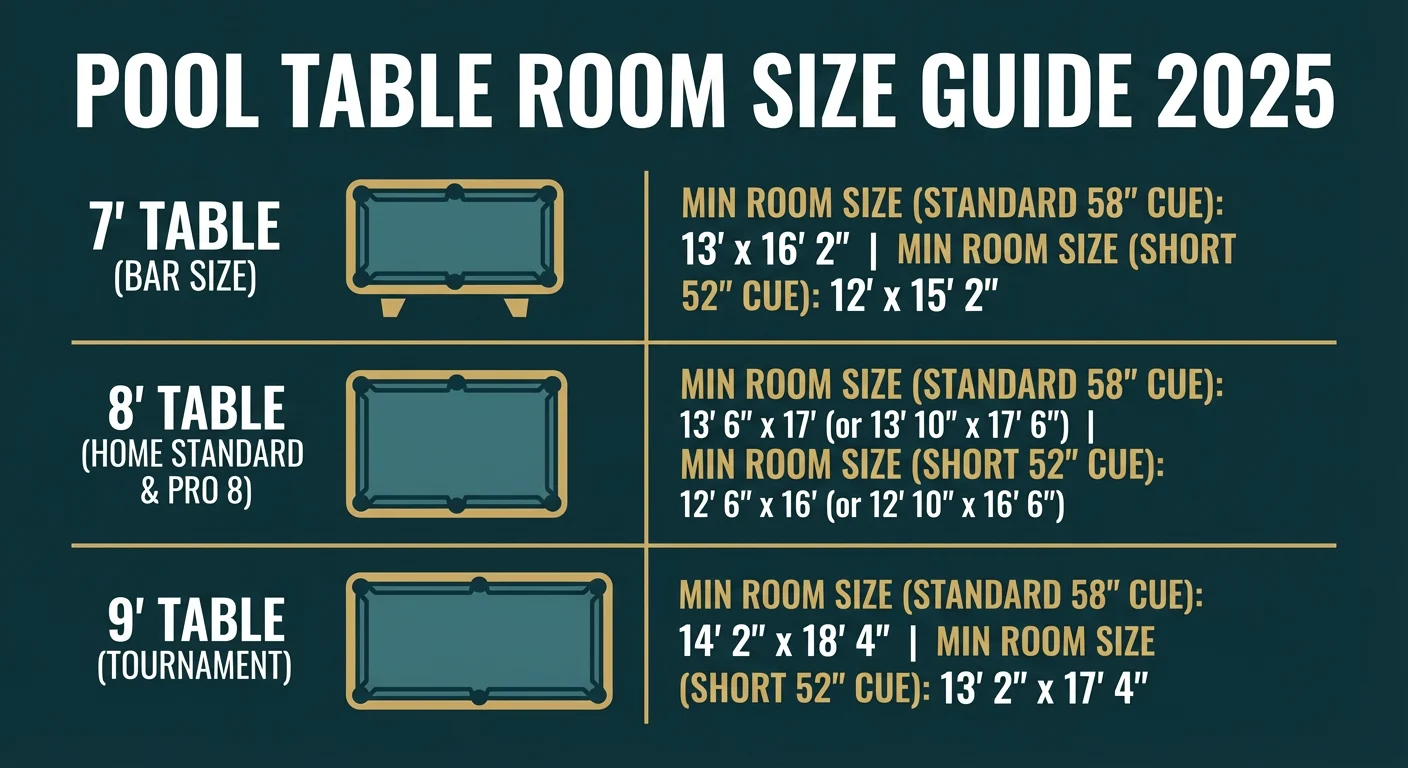
The Ultimate Pool Table Room Size Chart (Quick Answer)
If you are looking for a quick answer, start here. This chart calculates the minimum room dimensions based on the two most common variables: the size of the table and the length of the cue. How to read this chart:
- Best Experience: Use the Standard 58″ Cue column. This gives you professional-level clearance.
- Tight Space? Check the Short 52″ Cue column. This is your “safe minimum” to avoid hitting walls.
| Pool Table Size | Playing Surface Dimensions | Min Room Size (Standard 58″ Cue) Start Here | Min Room Size (Short 52″ Cue) For Tight Spaces |
|---|---|---|---|
| 7′ Table (Bar Size) | 39″ x 78″ (0.99m x 1.98m) | 13′ x 16′ 2″ (3.96m x 4.93m) | 12′ x 15′ 2″ (3.66m x 4.62m) |
| 8′ Table (Home Standard) | 44″ x 88″ (1.12m x 2.24m) | 13′ 6″ x 17′ (4.11m x 5.18m) | 12′ 6″ x 16′ (3.81m x 4.88m) |
| 8′ Oversized (Pro 8) | 46″ x 92″ (1.17m x 2.34m) | 13′ 10″ x 17′ 6″ (4.22m x 5.33m) | 12′ 10″ x 16′ 6″ (3.91m x 5.03m) |
| 9′ Table (Tournament) | 50″ x 100″ (1.27m x 2.54m) | 14′ 2″ x 18′ 4″ (4.32m x 5.59m) | 13′ 2″ x 17′ 4″ (4.01m x 5.28m) |
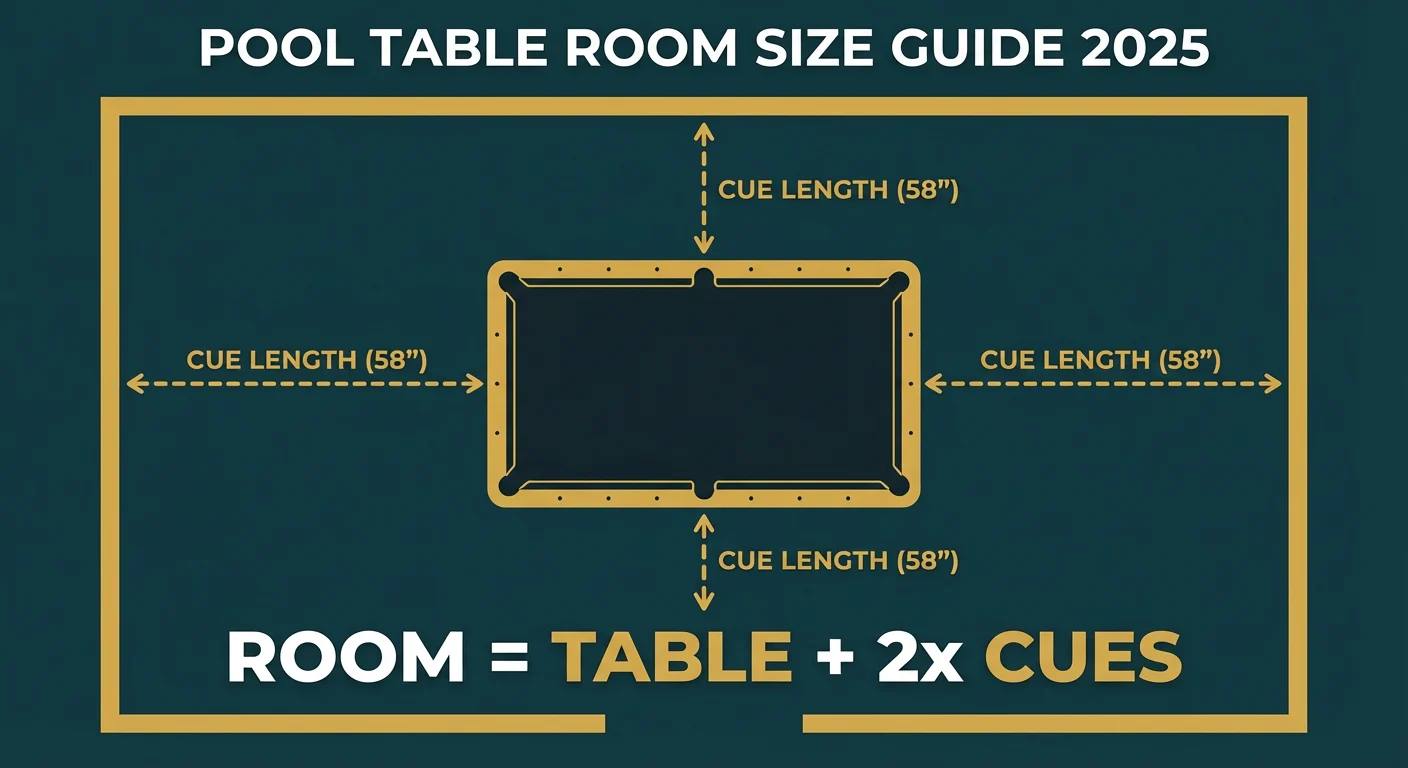
The “Golden Formula”: How to Calculate It Yourself
Don’t see your specific table size above? Or maybe you just want to double-check the math before calling the movers? Here is the simple formula used by pros to determine the absolute minimum space required.The logic is simple: You need enough room for the table itself, plus the length of your cue stick on both sides of the table (for those shots where you are leaning over one rail and shooting towards the opposite one).
The Formula: Room Length = Playing Surface Length + (2 x Cue Length) Room Width = Playing Surface Width + (2 x Cue Length)
Let’s look at a real-life example: Say you are buying a standard 8-foot Home Table (Playing surface: 88 inches long) and you plan to use a standard 58-inch cue.
- Length Calculation: 88″ (Table) + 58″ (Cue) + 58″ (Cue) = 204 inches (or 17 feet).
- Width Calculation: 44″ (Table) + 58″ (Cue) + 58″ (Cue) = 160 inches (or 13 feet, 4 inches).
So, for this setup, your room needs to be at least 13′ 4″ x 17′.If your room is smaller than this number, don’t worry. You haven’t hit a dead end yet. Read on for the solution that saves 90% of “too small” game rooms.
Prefer to skip the math? We built a custom calculator to do the hard work for you. Simply enter your room dimensions below to see exactly what fits:
🎱 Will It Fit?
Enter your room dimensions to check compatibility.
*Fits perfectly: Based on standard 58" cues.
*Tight fit: Requires 52" short cues.
Too Tight? 3 Ways to Fit a Table in a Small Room
So, you’ve measured your room, checked the chart above, and realized you are 4 inches short. Does this mean you have to kill your dream of owning a pool table?Absolutely not.Before you tear down a wall or cancel your order, consider these three “compromise” solutions that allow thousands of homeowners to enjoy pool in tighter spaces.
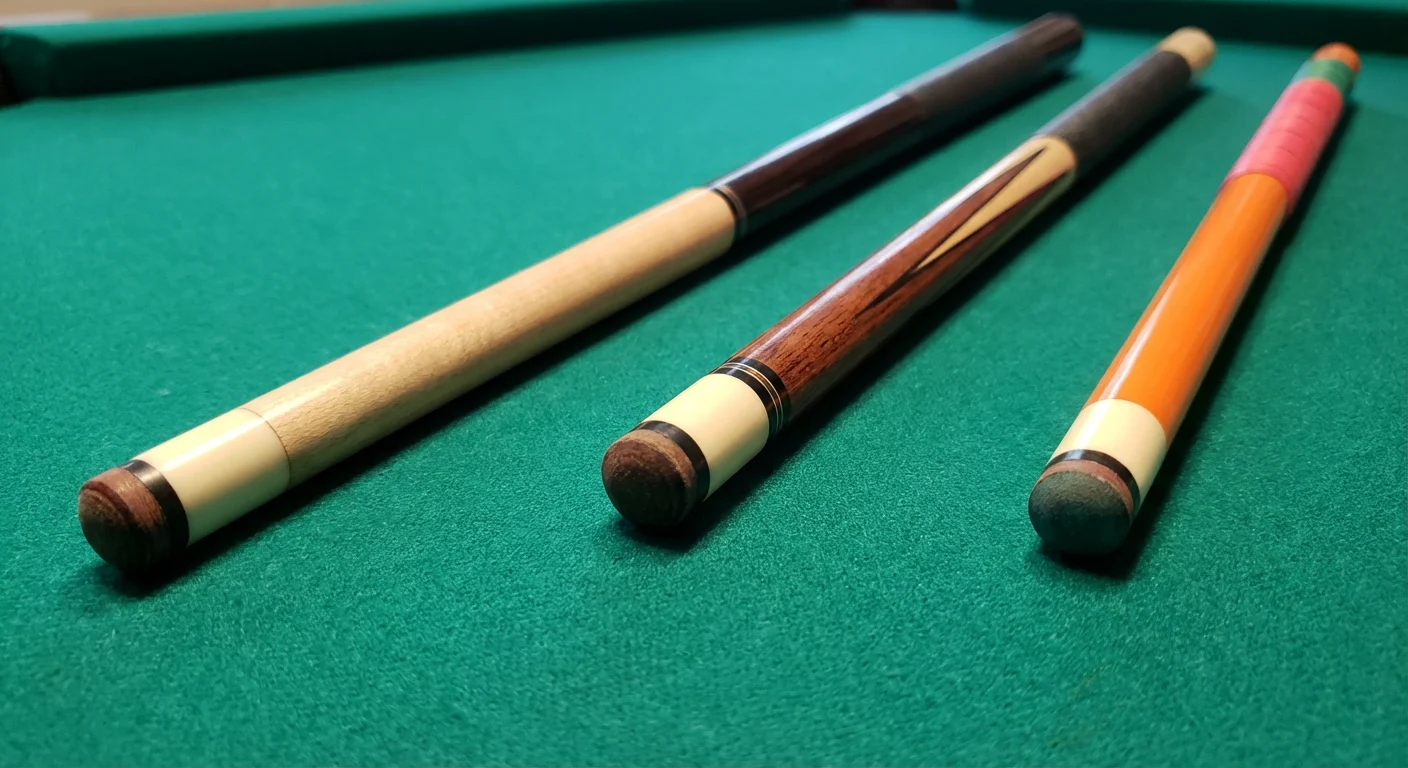
1. Use Short Cues (The Savior)
This is the most common solution. A standard pool cue is 58 inches long. However, you can easily buy shorter cues—52 inches or even 48 inches—specifically for those tight shots near a wall or a column.
- Does it ruin the game? Hardly. Unless you are training for professional tournaments, you likely won’t notice a huge difference in balance with a 52-inch cue for occasional shots.
- The Strategy: You don’t need to use the short cue for every shot. Keep your standard cues for 95% of the game, and just switch to the “shorty” when the cue ball lands near that one tight corner. It’s a small trade-off for having a table in your home.
2. The “Angled” Setup
Most people instinctively place their pool table parallel to the walls. But if your room is square or slightly irregular, try placing the table diagonally.By angling the table, the corner pockets point towards the corners of the room (which are usually the deepest parts of the space). This can often buy you an extra 1-2 feet of cueing clearance where you need it most.
3. Go British (7ft Tables)
If you are really tight on space, consider an English-style pool table (often called a “Blackball” table). While American 7-foot tables typically have a 39″ x 78″ playing surface, traditional English tables use slightly smaller balls and pockets. They are compact, fun, and designed specifically for smaller pub environments.
The “Blue Tape Method”: Visualize Before You Buy
Numbers on a screen are abstract. Your basement is real.If you are still on the fence about whether the table will feel “too big” or if it will block the walkway to the bathroom, don’t rely on math alone. Use this contractor trick to physically visualize the footprint.What you need:
- A roll of blue painter’s tape (or masking tape).
- A tape measure.
- Your standard pool cue (or a broomstick cut to 58 inches).
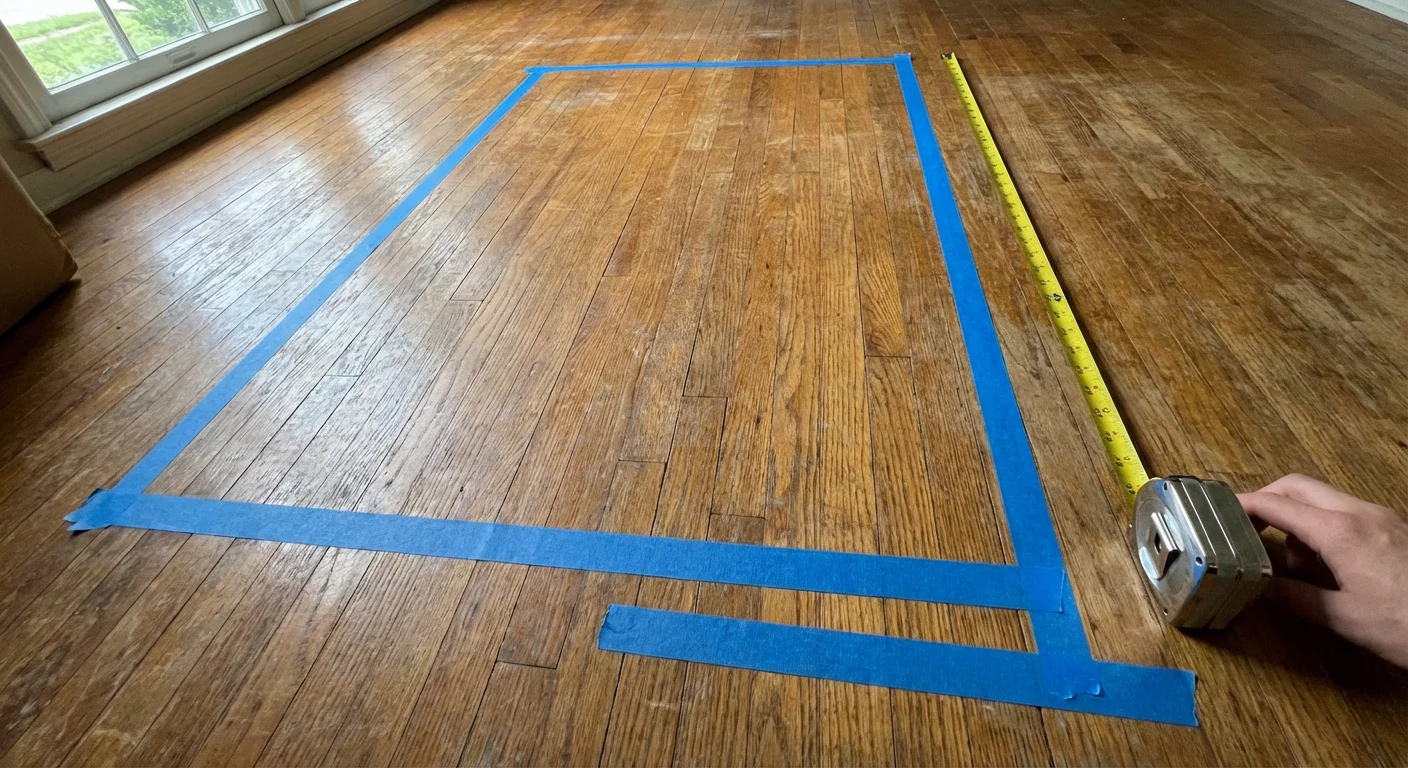
The Steps:
- Measure the Playing Surface: Don’t just tape the outer dimensions of the cabinet. Measure the playing surface (e.g., 44″ x 88″ for an 8′ table) and mark that rectangle on the floor with your tape.
- Add the Cabinet: Add roughly 5-6 inches around that rectangle to represent the rails (the outer edge of the table).
- The “Shadow Stroke” Test: Stand at the edge of your taped outline. Hold your cue or broomstick perpendicular to the tape (as if you were taking a shot).
- Walk the Perimeter: Move all the way around the table while holding the cue in shooting position.
What to look for:
- Does the butt of the cue hit the wall?
- Does it hit a shelf, a fireplace mantel, or a support pole?
- Do you have to squeeze your body sideways just to walk past the “table”?
If you can walk the entire perimeter and take a mock shot from every angle without hitting an obstruction, congratulations—your room is ready.
Watch Out for “Space Killers”: Furniture & Poles
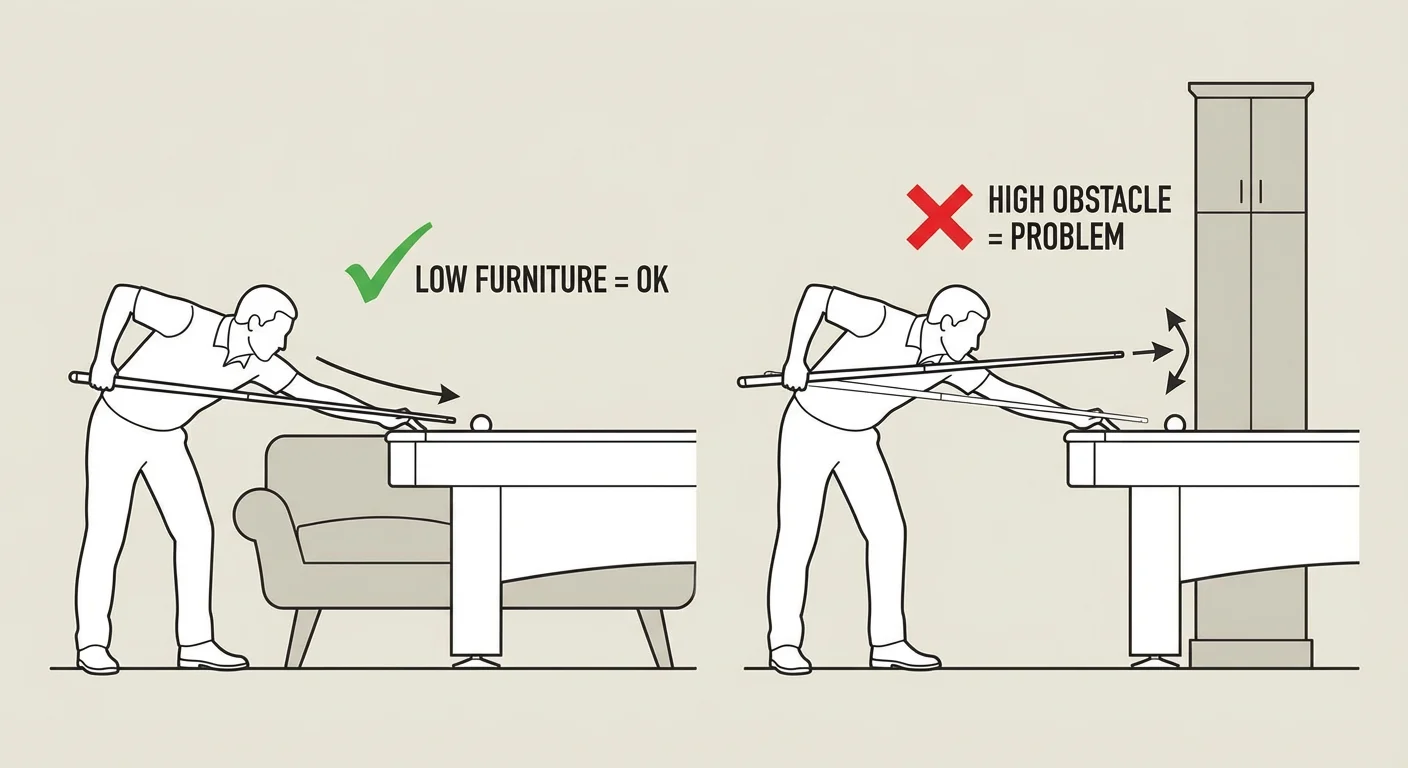
Even if your room dimensions are perfect on paper, physical obstructions can still ruin the game. However, not all obstacles are created equal. You need to distinguish between “hard obstacles” and “soft obstacles.”
- The “Soft” Obstacles (Low Furniture): Here is the good news: Height matters more than width. Furniture that sits below the height of the pool table playing surface (approx. 29-31 inches) is usually fine.
- Example: You can place a low sofa or coffee table as close as 3 feet from the pool table. Since your cue can pass over the furniture during a shot, it doesn’t count as an obstruction.
- The “Hard” Obstacles (Poles & Cabinets): Basements often have structural support columns. A pole can be a deal-breaker, but only if it’s in the wrong spot.
- Side Pocket (Safe-ish): If a pole aligns with the side of the table (near the side pockets), you might get away with it.
- Corner Pocket (Danger Zone): If a pole stands near a corner pocket, it will block some of the most common shots in the game.
FAQ: Common Questions About Pool Table Sizes
Can I fit a pool table in a 12×12 room?
Strictly speaking, a standard 8-foot table will not fit comfortably in a 12×12 room, as you would need short cues for almost every shot. However, a 7-foot table combined with 48-inch cues is a playable option for casual family fun. Alternatively, consider a “Bumper Pool” table, which requires significantly less space.
What is the standard size of a home pool table?
The most common size for home use in the USA is the 8-foot table (44″ x 88″ playing surface). This is considered a “mid-size” table—larger than a bar table (7-foot) but smaller than a professional tournament table (9-foot).
How much clearance do you ideally need around a pool table?
For a frustration-free game using standard 58-inch cues, you ideally want 5 feet (60 inches / 1.52m) of clear space on all four sides of the table’s playing surface.
Conclusion: Ready to Play?
Fitting a pool table into your home is a game of inches, but it’s a game you can win.Remember the golden rule: Room Size = Playing Surface + (2 x Cue Length). If your space is perfect, congratulations—you are ready to order your dream table. If your space is a little tight, don’t let that stop you. Grab a set of 52-inch cues, use the “Blue Tape Method” to confirm the layout, and get ready to break. A slightly cozy game room is always better than no game room at all.