There is nothing worse than a “soft break.” You hit the cue ball as hard as you can, but the rack just… thuds. The balls barely move, and the game starts with a mess.
Usually, the problem isn’t your swing—it’s how the balls were racked.
Knowing how to set up pool table balls correctly is the foundation of a fair and exciting game. Whether you are a beginner hosting a game night or a social player arguing over “bar rules” with your friends, this guide will settle the debate.
Below, we cover the official WPA (World Pool-Billiard Association) rules for the standard 8-Ball setup, plus the diamond racking for 9-Ball. We’ll also share a pro tip on how to get a “frozen” rack—where the balls are so tight they touch perfectly—for that explosive break you see on TV.
Quick Reference: The 8-Ball Cheat Sheet (TL;DR)
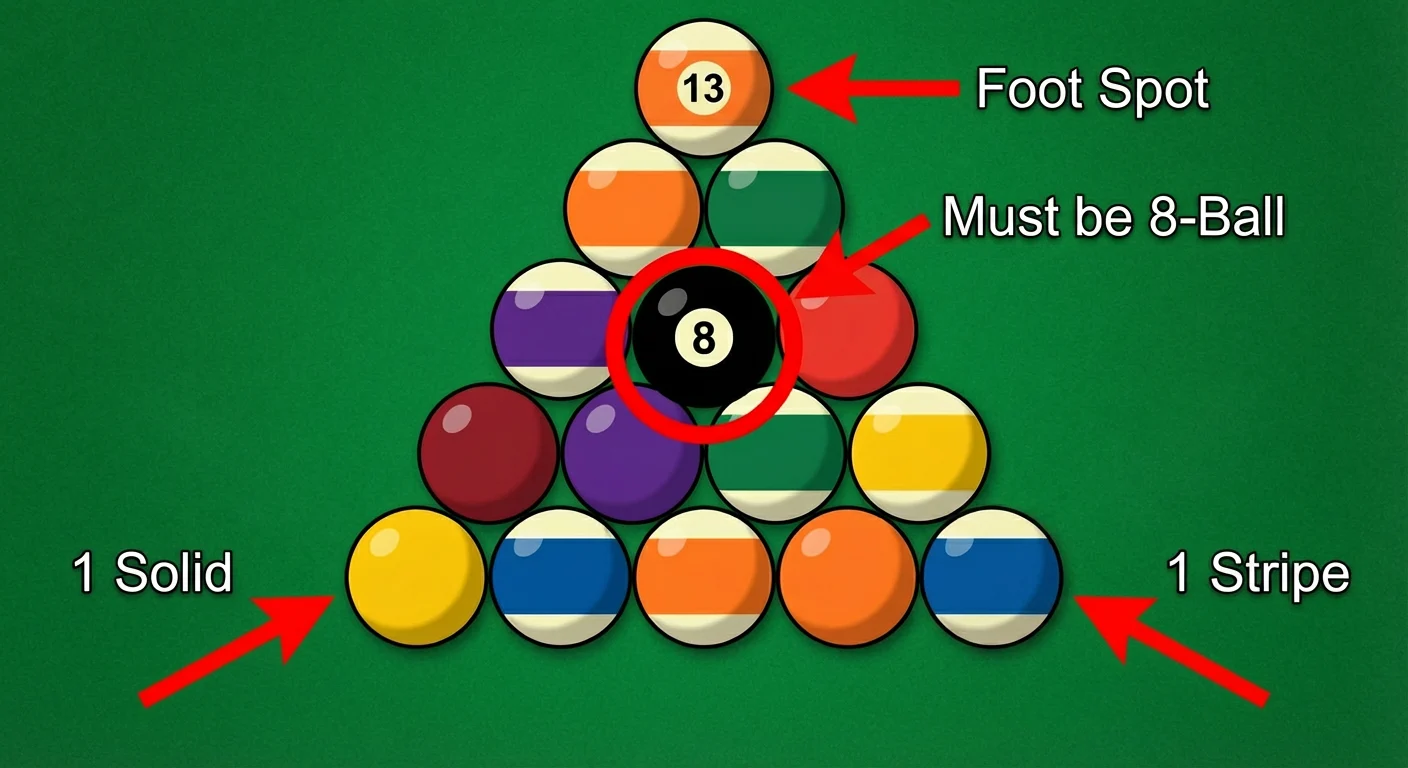
In a rush? Here is the standard 8-ball diagram. If you remember nothing else, remember the “Triangle Rule”:
The 3 Golden Rules:
- The 8-Ball goes in the dead center.
- The Bottom Corners must be different (one stripe, one solid).
- The Apex Ball (the front one) goes on the foot spot.
- The Rest? Random! You do not need to alternate every single ball pattern (Stripe-Solid-Stripe). That is a myth.
The Standard 8-Ball Rack Setup (Step-by-Step)
8-Ball is the most popular billiard game in the world, but it is also the one with the most “made-up” rules. If you want to play by professional standards (like the WPA or BCA), forget what the guy at the local bar told you.
Here is exactly how to rack 8-ball correctly, ball by ball.
Step 1: Place the Apex Ball on the Foot Spot
The “Apex Ball” is the single ball at the very front of the triangle.
- This ball must be placed directly on top of the Foot Spot. (The Foot Spot is the marked dot on the table, usually found at the end opposite to where you break).
- Which ball goes here? It can be any ball—solid or stripe—except for the 8-ball. Most people use the 1-ball simply for aesthetics, but it is not required by the rules.
Step 2: The 8-Ball Must Be in the Center
This is the most critical rule. The black 8-ball must always be placed in the center of the third row.
- Why? If the 8-ball is placed anywhere else, it might be pocketed too easily on the break, which can lead to confusion about whether the game is won or lost instantly. Placing it in the middle keeps it safe and fair.
Step 3: One Solid, One Stripe in the Bottom Corners
Look at the two balls in the bottom corners of the triangle (left and right).
- You must place one Solid (numbered 1-7) and one Stripe (numbered 9-15) in these corners.
- Does the side matter? No. You can have the solid on the left and stripe on the right, or vice versa.
- The Reason: This arrangement ensures that when the balls scatter after the break, both players have a roughly equal chance of having their object balls spread across the table.
Step 4: Randomize the Rest
A common misconception is that you must alternate the entire rack (Solid-Stripe-Solid-Stripe…). You do not need to do this.
- Aside from the Apex ball, the 8-ball, and the two corner balls, the remaining balls can be placed randomly.
- Don’t waste time trying to create a perfect pattern. As long as the three main rules above are followed, your rack is tournament-legal.
[Editor’s Note: Image Suggestion] Insert a close-up photo of the bottom corners of the rack.
- Caption: “Correct Setup: Notice the bottom corners feature one stripe and one solid.”
Other Games: 9-Ball and 10-Ball Setup
Once you have mastered 8-ball, you might want to try the faster-paced rotation games. The setup rules are different, and for 9-ball, the shape of the rack changes entirely.

How to Rack 9-Ball (The Diamond)
Unlike 8-ball, 9-ball uses a diamond-shaped rack (1-2-3-2 pattern). You only use balls numbered 1 through 9.
- The Shape: Use a specific diamond rack if you have one. If you only have a standard triangle, place the balls in a diamond shape within the triangle (it’s a bit trickier to get tight, but possible).
- The 1-Ball: Must be at the Apex on the foot spot.
- The 9-Ball: Must be in the exact center of the diamond.
- The Rest: Placed randomly around the 1 and 9.
How to Rack 10-Ball
10-Ball is becoming increasingly popular in professional tournaments because it relies less on luck than 9-ball.
- The Shape: It uses a small triangle (rows of 1, 2, 3, and 4 balls).
- The 1-Ball: At the Apex on the foot spot.
- The 10-Ball: In the center of the third row (where the 8-ball would be).
- The Rest: Random.
Pro Tip: How to Get a “Tight Rack” (The Secret to a Good Break)
Have you ever hit a perfect break shot, only to hear a dull “thud” and see the balls barely move? That is caused by a loose rack.

For a powerful, explosive break, the balls must be “frozen”—meaning every single ball is touching its neighbors with zero gaps. Here is how the pros do it:
1. The “Push Forward” Technique
Don’t just drop the balls in the triangle and lift it up.
- Step A: Place your fingers behind the back row of balls.
- Step B: Push the balls forward towards the apex ball while simultaneously applying downward pressure.
- Step C: While pushing, slide the rack slightly forward to the foot spot. This friction helps lock the balls together.
2. Check for “Spinners”
Before you lift the rack, try to spin the perimeter balls with your fingers.
- If a ball spins freely, it means it is not touching its neighbors.
- Adjust the angle of the rack or swap that ball with another one until everything is tight.
3. Upgrade Your Gear: Magic Rack vs. Triangle
If you are playing on an older table with worn cloth, getting a tight rack with a wooden triangle is almost impossible.
- The Solution: Consider using a template rack (often called a “Magic Rack”).
- This is a thin plastic film that sits under the balls. It holds them perfectly in place with microscopic holes, ensuring a “frozen” rack every single time. It is the gold standard for modern pool.
Frequently Asked Questions (FAQ)
Here are the most common questions beginners ask about racking pool balls.
Q: Does the pattern of solids and stripes really matter?
A: No, not as much as people think. Beyond the 8-ball in the center and the one-solid-one-stripe rule for the bottom corners, the rest of the balls can be placed randomly. You do not need to alternate them in a specific pattern like “Stripe-Solid-Stripe.”
Q: What if the table is uneven and the balls roll away?
A: This is a common annoyance on older tables. If the apex ball won’t stay on the foot spot:
- Tap it: Gently tap the ball down with the cue ball to create a tiny indentation in the cloth (ask the table owner first!).
- Move slightly: You are allowed to move the rack a tiny fraction of an inch to find a flat spot, as long as the apex ball is still covering part of the foot spot.
- Use a Magic Rack: As mentioned above, template racks eliminate this problem entirely.
Q: What happens if I sink the 8-ball on the break?
A: It depends on the rules you are playing:
- Bar Rules / APA League: You usually win the game instantly!
- WPA / BCA Pro Rules: It is not a win. The 8-ball is spotted back on the table (or the rack is re-broken), and the player continues their turn.
- Tip: Always agree on this rule with your opponent before you start!
Conclusion: A Perfect Rack is Just the Beginning
Setting up the pool balls correctly is the sign of a player who respects the game. It ensures fairness, prevents arguments, and sets the stage for a great match.
Remember the basics: 8 in the middle, differ the corners, and get them tight.
Now that you have built the perfect rack, it is time to destroy it. A tight rack is useless if you don’t know how to transfer energy into the balls.